
Growth experimentation at Guru
Company
Guru Technologies
Learnings
A/B Experimentation
Increasing conversion
Research-informed designs
For three years, I worked on the growth team at Guru Technologies. I designed and executed experiments, driving design strategy, while collaborating with product managers and engineers to optimize the user experience from onboarding to conversion.
Why was our growth team created and what were our goals?
The core goal of this group was to engage users and drive retention by leveraging the entire user journey.
My role involved collaborating with the product team to develop assumptions, design experiences that allowed us to test those assumptions, while closely monitoring metrics.
We ran experiments targeted at specific criteria rather than general improvements: friction at the point of creation, contextual guidance during trial, personalized content, the analytics experience, and adjustments to content and permissions structure.
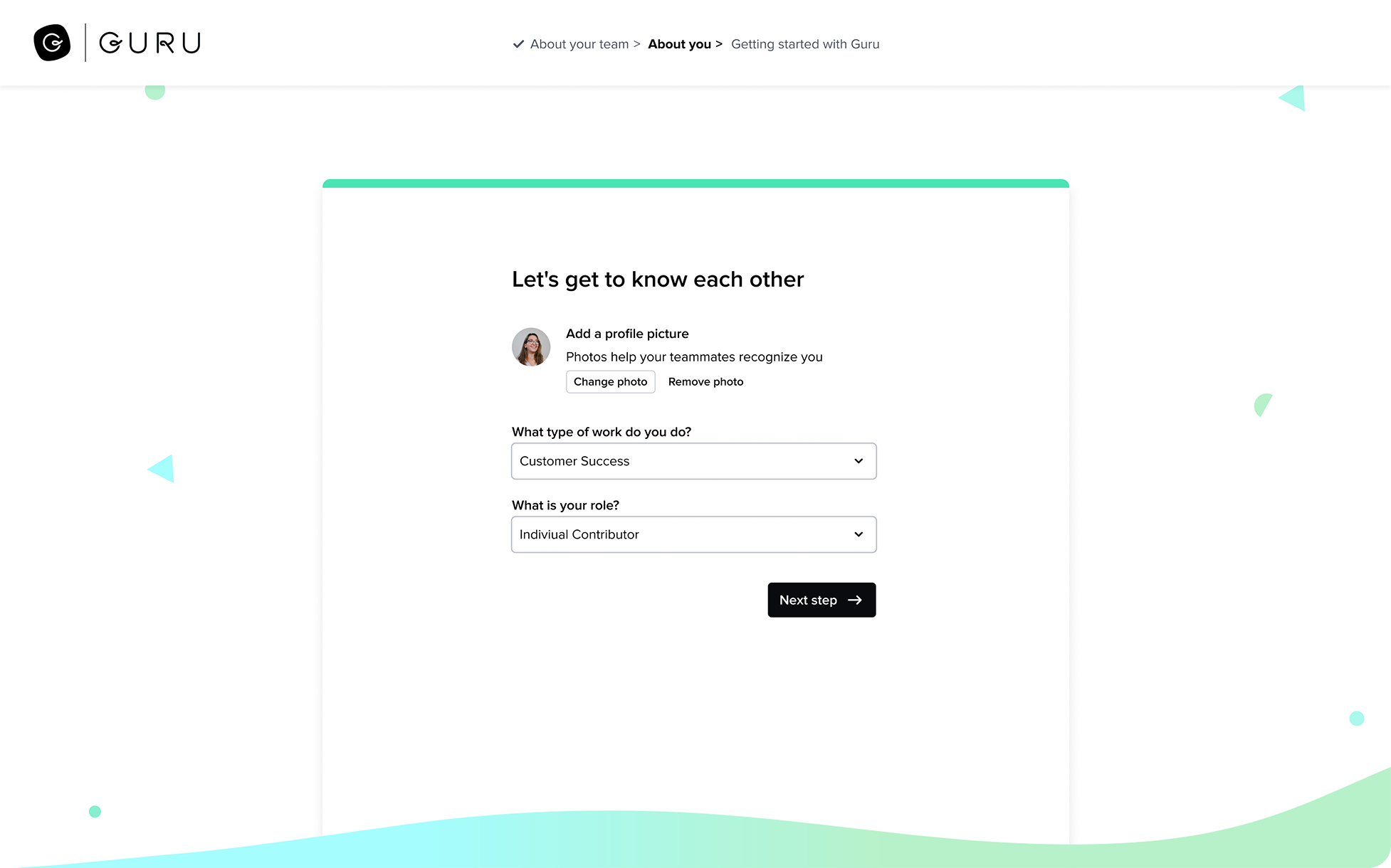
Example Experiement
After collecting role and department, we generated personalized content, testing templates against a control to determine which had the most publishes.
Our build cycle and process

A typical project had some level of research, solution betting, design, release prep & QA and were done within three weeks
How did we determine a hypothesis?
Problems derived from customer insights, data analysis, qualitative research
Scoring, feasibility, impact potential with cross-functional teammates
How did we setup a test group?
Create testing cohorts, determine control/variant groups and manage data collection

Some of my favorite findings:
What worked: Giving users clear and actionable goals during their trial led to a better chance at conversion for their team, and more engagement by added teammates.The second effect mattered more, it suggested activation was a team behavior, not an individual one.
Something we got wrong: Taking users to our integrations page instead of directly to the Chrome store led to a drop off in installations. Through research we learned users didn’t mind being redirected and preferred the direct approach, even if it was out-of-product.
What we learned about the score itself: We treated all three criteria as equal and unordered, and the data didn't support that. Weight varied by role, and sequence appeared to matter — connecting an integration before creating content looked different from the reverse. The checklist was hiding structure, and I recommended moving to a weighted, role-aware model

Growth principles
Throughout our work, we had guiding principles that kept us aligned during projects and allowed us to ensure as a team our work matched our initial vision.
